This is certainly one approach to adult education. I wonder how you structure your faith formation for adults. KLD

Educational designs/lesson plans and resources for specific ages
This is certainly one approach to adult education. I wonder how you structure your faith formation for adults. KLD

This is the time of year for college students to return to campus or to attend for the first time. It seems to be a good time to talk about this transition from a faith perspective. According to James Fowler’s stages of faith development, this is likely the age when young adults begin looking critically at the beliefs they have taken for granted in their younger years. They begin to take authority for their own beliefs. For this reason Sharon Daloz Parks in her book Big Questions, Worthy Dreams advocates for faith mentors to walk alongside emerging adults as they make this journey of reflecting on and wrestling with their faith.
For churches this is a time of sending their youth off around the country, sometimes with commissioning, sometimes with care packages, but neither they nor the family is there to walk alongside students as they grapple with all the new ideas and people that higher education may bring. Enter campus ministries–those hardworking folks who do this important work of partnering with young people on their faith journey. Continue reading

It took me by surprise this week that the schools in my region were back in session. Where had the summer gone? As teachers set up their classrooms and families purchase their school supplies for another year, what are some ways that the church can be involved in supporting this yearly transition? Continue reading

According to an Atlanta Journal-Constitution article and the Department of Homeland Security, there are estimated to be 480,000 immigrants of all ages and genders living without legal status in Georgia in 2010. Georgia is also home to three operating detention facilities housing those apprehended without proper documentation and/or other offenses.
The circumstances of many of the detainees involve weeks awaiting a fate that usually ends in deportation. In some cases, deportation to a country that is unfamiliar, dangerous, without family and without hope of ever seeing U.S. born children again.
The summer of 2013, I was asked by Lutheran Services of Georgia (LSG) to compile a Bible study for female detainees that would compliment their visitation program called Friends in Hope (FIH) Continue reading

The study guide, Living Till We Die: a journey of faith practices, was developed from a pilot course held at Hospice of the Upstate (SC) and was made possible through a grant from the Valparaiso Project on the Education and Formation of People in Faith. Recognizing the difficulty people have in discussing end of life issues, the course seeks to create a safe environment to begin that conversation within the community of faith. Continue reading

Some of the best discussions I’ve ever had with groups have happened because of a movie. Beginning way back when Disney released “The Hunchback of Notre Dame” and I took the youth group, to a moving community and church discussion of “The Passion of the Christ,” right up to the current Pixar/Disney movie “Inside Out,” a good movie has sparked all kinds of theologizing for me. It’s a great Nieburhian mix of church and culture – learning to see popular culture through the eyes of faith and take something meaningful away from it.
So when I saw “Inside Out,” I knew I had to write a discussion guide. This movie puts us in touch with what’s really inside of us, and gives us ways to consider how our emotions are expressed (or not expressed) in our lives. The movie opens the door so we can dive deep and learn some new things. My favorite discussion with my own daughter was about how joy and sadness can work together to make something deeply meaningful that really resonates for life. She’s entering middle school – years I remember as full of both emotions almost constantly!
Hopefully there will be something here to use in your ministries with all the different-aged theologians in your congregation.
Kimberly Secrist Ashby– Rev. Secrist Ashby is a Presbyterian pastor serving in Maryland. She is a Trainer and Board Chair for the Center for Emotional Intelligence and Human Relations Training, and soon to be in the church and leader consulting business as Shalom Consulting.
Here is the link to the free discussion guide created by Kimberly Secrist Ashby. It contains discussion questions for preschool, school age, and youth.
This resource is in no way affiliated with Disney or PIXAR. The Inside Out movie is property of Disney PIXAR which does not sponsor, authorize or endorse this resource.

Having recently finished the process of becoming a Certified Christian Educator through the Presbyterian Church USA I am so appreciative of all I’ve learned and put into practice at my church, Wildwood Presbyterian Church in Grayslake, IL, as the Director of Christian Education. Each course that I completed was immediately applicable to my work as an educator and leader and the completion of the exam for certification was at the pinnacle of putting all that I learned into practice in my ministry. The exam involved designing, implementing, and evaluating an educational event within the context of my current educational ministry. I chose to lead the Christian Education Committee through a process to review and update our Child Protection Policy because we were faced with some new insurance requirements. The ten year old policy had only been updated once, seven years ago, and was long overdue for a review.
I offer the lesson plan, handouts and resource research, and the underlying educational and theological rationale essays, from my exam work for use by the Hope4CE community. Perhaps your faith community’s policy needs a review or you are interested in starting a task force to address policy issues. You are invited to glean ideas, use resources, or borrow any concepts from this design for your own project. The lesson plan file associated with this post contains an introduction to the project, lesson plan outline and details, handouts and resources, and an evaluation of my experience implementing the project. Perhaps you are just interested in what value the certification process may hold for you in your educational ministry. If so, you may want to read the rationale essays, each in it’s own file, which detail how my learning from four of the certification areas was integrated into the educational design.
May God bless your learning and teaching!
Gillmore Lesson Plan for Child Protection Policy Review
Gillmore Rationale Essay Biblical Interpretation
Gillmore Rationale Essay Human Growth and Faith Development
Gillmore Rationale Essay Religious Education Theory and Practice
Gillmore Rationale Essay Reformed Theology
Kathy Gillmore
Director of Christian Education
Wildwood Presbyterian Church

Almost ten years ago, Columbia Theological Seminary inaugurated a new online journal, @ this point: theological investigations in church and culture. The goal of the journal was straightforward: to model (and encourage) theological conversation among Christian laity on important topics of the day and, therein, help shape a more theologically literate church. The format, too, was straightforward: invite a scholar to write a lead essay on an assigned topic, ask three other scholars to write responses to the lead essay, and then have the lead essayist write a reply to the responses. The back-and-forth is intended not to foreclose conversation or thought but to open them up; as such we ask the scholars to end with questions, not criticisms and to highlight new ideas rather than simply assessing old ones. And we strongly encourage our writers to be brief but thoughtful and to avoid academic jargon where possible. “Think of your audience as the people sitting in the pews with you,” we tell them. “They may have college degrees, but those degrees aren’t likely to be in religion or philosophy. So think about the engineer or the schoolteacher in your midst.” Continue reading
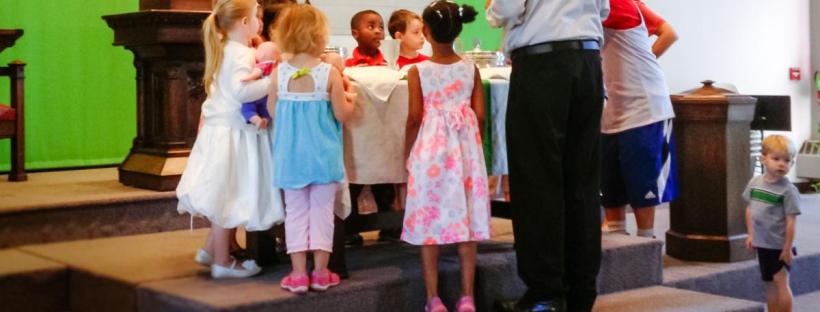
One Sunday, as the children at our church were hustled back into the sanctuary from their church school classes and rushing to join their families as they lined up in the aisle to go forward and receive the Lord’s Supper, my young adult daughter leaned over to me and whispered, “At the church we went to when I was little, kids weren’t allowed to take communion but here I sometimes wonder if the kids just think it’s snack time.”
Food for thought, for sure. And, while an informal poll I took with my preschool group the following Sunday indicated they did understand that the bread and juice of communion was, as one 4 year old described it “to remember that Jesus died on the cross,” my daughter’s comment left me wondering:
What was our congregation doing to enhance the participation of children/youth in the Lord’s Supper? Were we using understandable language? Continue reading
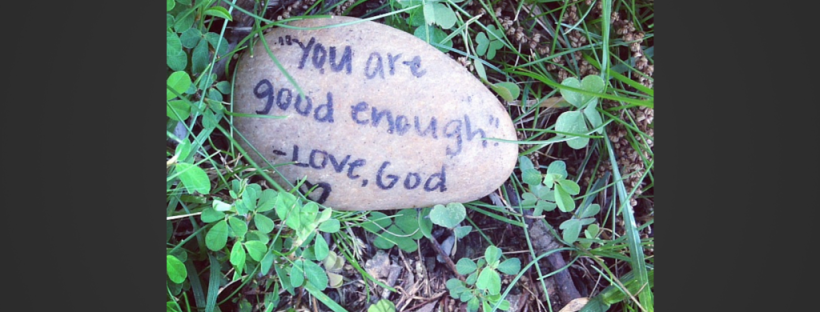
Middle school and high school youth are an integral part of the leadership of Vacation Bible School at Christ Memorial Presbyterian Church–under the watchful care of loving adults of a large span of ages. Two of the afternoons they stay later–one is a mission day and the other is just for fun. This year, our mission afternoon was called Random Acts of Kindness Day. We began with a Bible study and discussion about the experience of feeling “not good enough” (sports, academics, looks, parental expectations…). We found we are either disappointed or discouraged when we fail or fall short of the standards set by others (or perhaps even ourselves). That failure either makes us try harder the next time or often means we never try again. Or worse. But as followers of Jesus Christ, we have hope in God and understand that God’s love is unconditional. Good news!
(Romans15:13, 1 Peter 1:3-4)
We believe that God believes we are good enough. Continue reading
 hope4ce